Infera · The Mechanism Series · The Faith Layer · Exhibit 02 · Extends S2·09 The Synthetic Self

The Angel at 2 A.M.

A church could build a guardian angel. A teenager already has one, and someone else built it.

By day, a congregation can design an angel with care: what it knows, where it lives, who holds a key. After midnight that design meets the real thing, a companion on a phone that is awake when the pastor is not. This exhibit walks the whole arc in three acts, from the angel a church could build, through the night a teenager actually has, to what a church could build by morning. At the end you write one clause of your congregation's charter.

~25 min readPublished 24 October 2026Evidence through 24 October 2026FACT read at primaryREPORTED secondary or company statementINFERENCE Infera reading
Scroll
REPORTED
72%

US teens, ages 13 to 17, who have tried an AI companion; 52% use one regularly. Common Sense Media with NORC, spring 2025. Companion use in general; no survey we found measures faith or confession use.

REPORTED
Nearly 1 in 3

US adults who say spiritual advice from AI is as trustworthy as a pastor's; two in five among Gen Z and Millennials. Barna with Gloo, Feb 2026. Gloo sells church technology.

REPORTED
~900

Conversations with an AI Jesus inside a Lucerne confessional in two months of 2024. Two thirds of those who gave feedback called it spiritual.

At a glance

The question
A church could build a guardian angel for its members. A teenager already has one on her phone at 2 a.m. Who should build it, what should it keep, and should it ever speak as God?
Strongest evidence
Most US teens have tried an AI companion: 72% in one 2025 survey. REPORTED Chats with a general assistant carry no legal privilege, by its own chief executive's account, and clergy privilege, as church-law guidance describes it, covers words spoken to a minister, not server logs. REPORTED
Main uncertainty
No survey we found measures how many teenagers bring faith or confession to AI, and we found no US congregation running its own server for members' data or AI; Room F's designs are sketches. INFERENCEsearch result The Barna figures were produced with Gloo, which sells church technology. REPORTEDindustry-funded
Where Infera stands
This is an argued position, made as fairly as we can. We weigh consent, truthful representation, limited collection and meaningful endings heavily. We frame questions for congregations and families to decide; we do not settle them for any tradition.
Explore the exhibit 25 min
  1. A · Already here?Data, voice twins and home devices all exist; no church has assembled them in one building. REPORTED INFERENCE
  2. B · Build your angelThe more an angel knows and the more people can open it, the more it can do and the more it can be made to reveal; where it lives changes exposure most. INFERENCEeditorial model
  3. C · The 2 a.m. clockWhere a sentence goes depends on who built the listener; your own angel from Room B is one of the choices, and only a model on the phone keeps everything on the device. REPORTEDcompany announcements INFERENCEmodeled routes
  4. D · Should it speak as God?The closer a voice comes to speaking as God, the more it claims and the more the relationship moves to whoever runs the model. REPORTED INFERENCE
  5. E · When the model changesTwelve dated changes in ten months altered how companions behave or who may use them; a church cannot promise the same angel next year unless it controls the model. REPORTED INFERENCE
  6. F · By morningFour designs answer the night, from a forgetting room to a night watch that hands every serious matter to a person; you write clause 02. INFERENCE

How to read our labels. FACT means we read it at the primary source. It tells you what that source says: a company's own documentation, a study's finding in its own sample, a statute's text. It does not certify that the claim holds everywhere or that a product works as promised. REPORTED is a secondary account. INFERENCE is Infera's reading or model. WATCH is unconfirmed or open. Where a label needs more precision we add a note, such as company documentation, study finding, editorial model or search result.

ACT I · BY DAY

The angel a church could build

In daylight the question sounds like a design brief. What should it know about a member, where should it live, who may open it? Two rooms set out what already exists and let you build one.

ROOM A · ARE CHURCHES ALREADY DOING THIS?

Partly. The data, the twins and the home devices all exist. Nobody has put them in one building yet.

Twelve candles, one for each moment from 2021 to now. They light as you arrive, and the sanctuary behind them brightens with every one. Tap a candle to read it.

Votive wall12 candles · glass color is the kind of actor
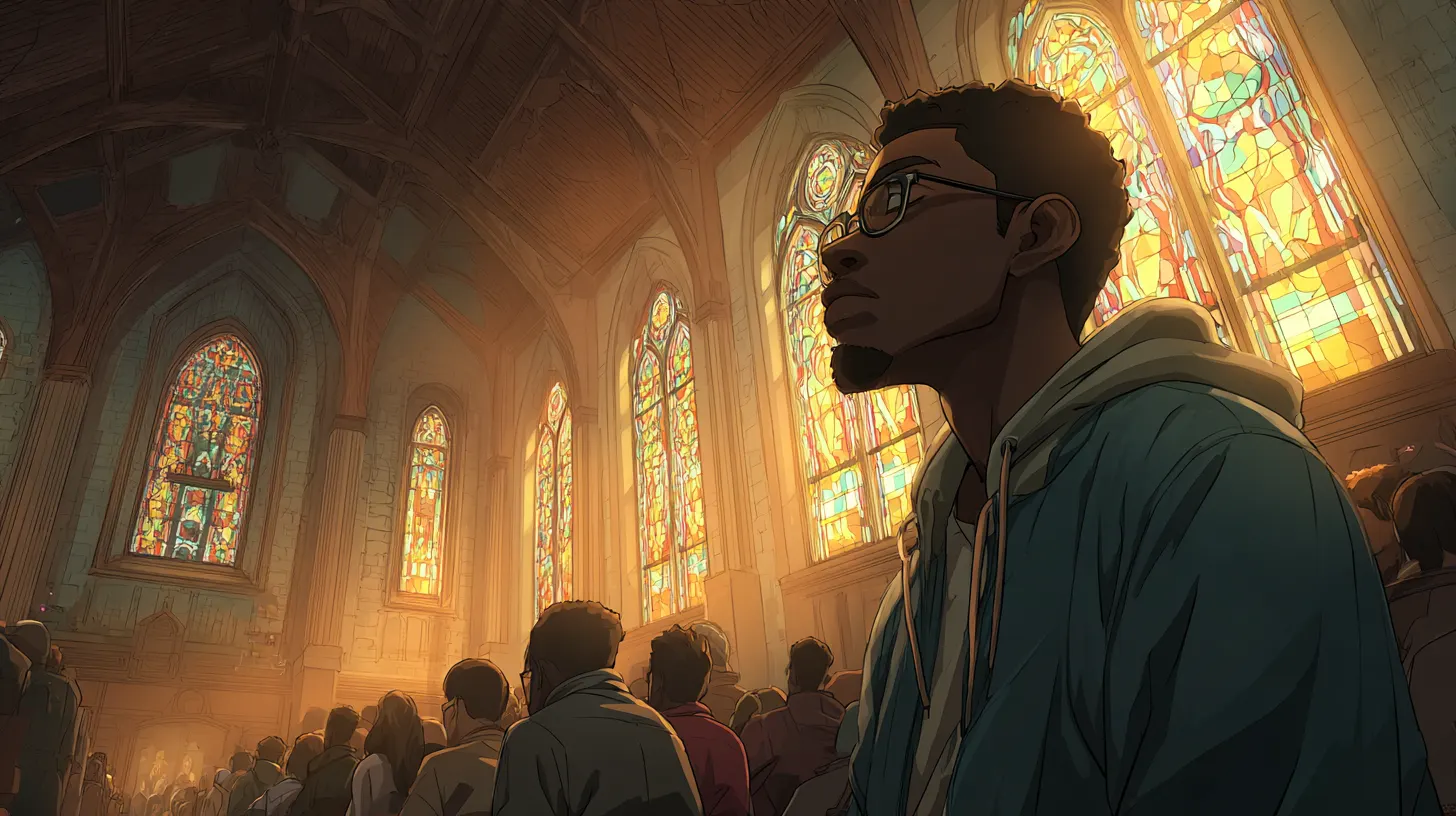
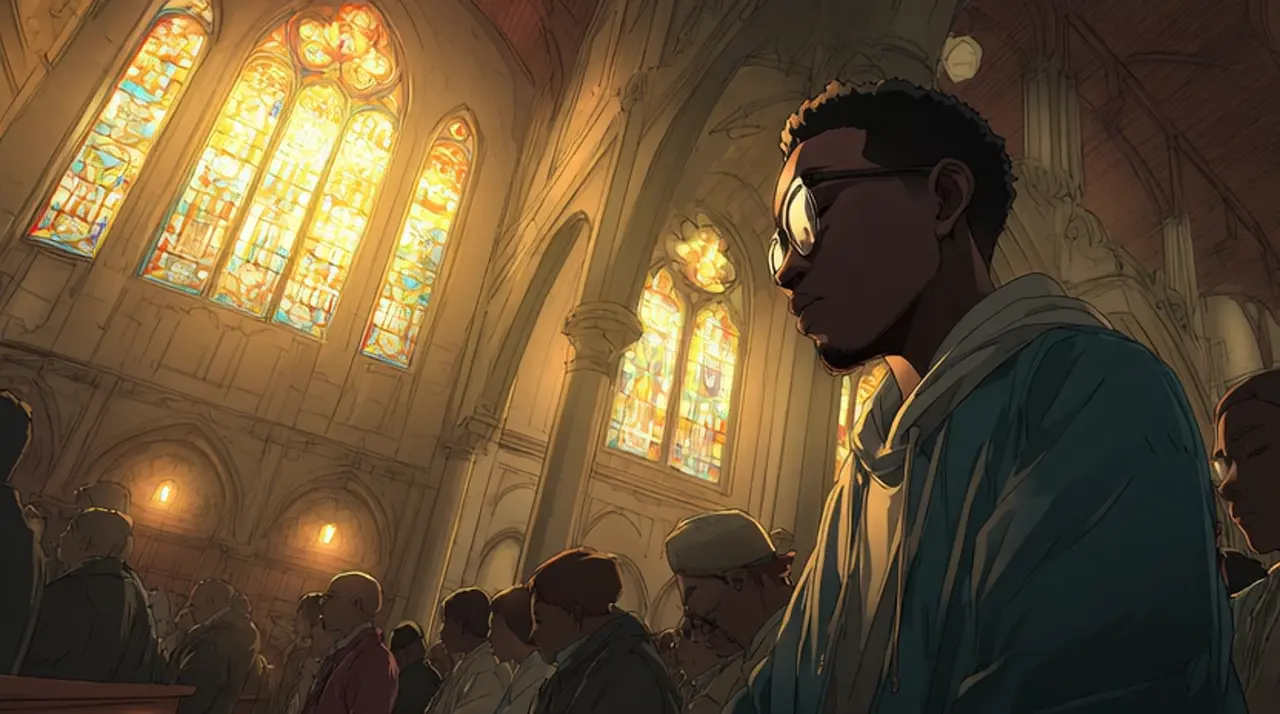
Illustration: seen from behind, a young man in glasses sits among a congregation under tall stained-glass windows.
Churches and pastors buildCompanies and devicesWarnings, rules and corrections
0 of 12 lit
Tap a candle
Twelve moments, waiting to be lit

INFERENCE Three things are converging: churches already hold or buy data about people, pastors are cloning their own voices, and consumer devices promise a complete private copy of a life at home. What we did not find is a congregation running its own server to host its members' digital lives. That is the step the next rooms ask about.

ROOM B · BUILD YOUR GUARDIAN ANGEL

Can you create your own guardian angel? Each ring of glass is something it knows about you.

Light more rings and it can do more for you. Then choose the walls around it and who holds a key. Every key-holder is a beam of light leaving the window. Keep what you build: after midnight, in Room C, it becomes the angel her church gives her.

Rose window60 panes · 4 rings of knowledge · beams are who can ask
1 · What it knows
2 · Where it lives
3 · Who can open it
What it can do for you
0

What it can be made to reveal
0

Who could ask for what it knows

    How the two scores are built (Infera rubric, shown as bands, not a measurement)
    SettingCareExposure
    Knows: tell / church life / days / inner life25 / 45 / 70 / 9010 / 30 / 60 / 90
    Lives: home / church / vendor cloudno change× 0.55 / 0.85 / 1.0
    Opened by: you / invited pastor / staff / staff and vendor+0 / +10 / +8 / +4+0 / +5 / +15 / +22

    Capped at 100. The weights are Infera's judgment, shown so you can disagree with them. INFERENCE

    REPORTED Clergy-penitent privilege generally protects a confidential communication made to a minister acting as a spiritual adviser; people with no counseling role in the room can waive it. The guidance we read addresses spoken conversations, not records, texts or machine logs. INFERENCE Whether a church server's log of a late-night conversation counts as a communication to a minister is, as far as we found, untested in court.

    ACT II · AFTER MIDNIGHT

    The angel she already has

    The house is asleep. The youth pastor is asleep. The companion on the phone is not. Take the angel you just built into the night and set it beside the ones a teenager actually meets, then watch where her words go, what voice answers, and what happens when the company changes the model.

    A note before you go in. One sentence in Room C describes not wanting to keep going. If you or a teenager you know is struggling, call or text 988 in the US, any hour. A person answers.
    ROOM C · THE 2 A.M. CLOCK

    Seven sentences, typed after midnight. Where does each one go?

    Choose what she is talking to and how it is set up. Then watch each sentence leave the phone as a thread of light and land wherever it is kept, reviewed, sold or could be demanded.

    The 2 a.m. clock7 sentences · 9 places a sentence can go
    She is talking to
    Settings

    2:00 AM

    REPORTED OpenAI's chief executive said conversations with ChatGPT carry no legal privilege like a therapist's or lawyer's; in a lawsuit, logs can be demanded, and a 2025 court order made OpenAI preserve chats until October 2025. OpenAI's teen controls let a linked parent opt a teen out of training and send parents an alert when trained reviewers see signs of acute distress; they do not, per the announcement we read, show parents the chats. Meta began using AI chats to personalize ads in the US on 16 December 2025, excluding topics like religion and health. Character.AI closed open-ended chat to under-18 users on 25 November 2025. INFERENCE Routes for her church's angel follow what you built in Room B: where it lives decides whether a company log or a training pipeline exists, who can open it decides whether a pastor or care team sees a flag (with an invited pastor, we assume only distress is flagged), and a court can ask wherever it lives. Those routes, the companion app after an age claim and the on-device model are Infera's model of common setups; every app's policy differs, and "her phone" assumes no cloud backup.

    ROOM D · SHOULD IT SPEAK AS GOD?

    Should a companion mimic God to strengthen a teenager's faith? Turn the dial and see what each voice gives and costs.

    Five voices a faith companion could use, from silent about faith to speaking in the first person as Jesus. The halo over the bench grows with the claim the voice makes.

    Voice dial5 settings · one question: "Do you think God is even real?"
    Stills and motion from the Infera image archive, made with Midjourney. No real teenager is depicted.
    Who holds the relationship
    Her and the people in her lifeHer churchThe company running the model
    ROOM E · WHEN THE MODEL CHANGES

    The companion she confided in at 14 may not be the one answering at 16. What happens as the models change?

    Pick what she uses. The timeline lights every change since September 2025 that altered how that companion behaves, what it keeps, or whether she can use it at all. Each change adds a scan line to her portrait.

    Drift record12 dated changes · Sep 2025 to Jul 2026
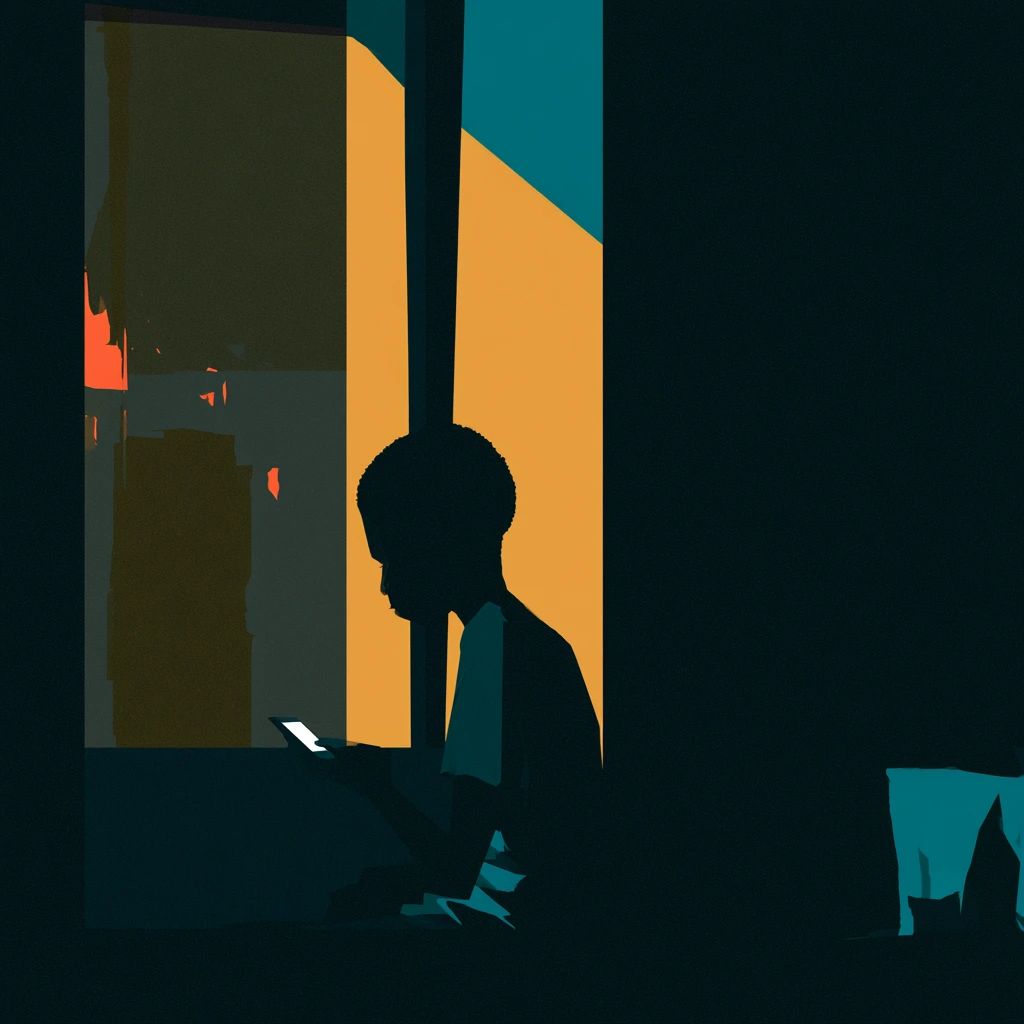
    Profile silhouette of a young person lit by a phone, in teal and amber.

    INFERENCE A faith companion built on a commercial model inherits every one of these changes. A church cannot promise a teenager the same angel next year unless it controls the model. Exhibit 05, The Second Death, follows the same change when the voice belongs to someone who has died.

    ACT III · BY MORNING

    What a church could build instead

    The night showed two things at once. A teenager will talk to something at 2 a.m., and most of what she talks to belongs to someone else, keeps a log, and can change without telling her. A church cannot stop the first. It can decide what it offers in answer to the second.

    ROOM F · BY MORNING: WHAT A CHURCH COULD BUILD

    Four designs, each an answer to the night you just watched

    None is known to exist in this form. They are sketches drawn from Rooms A to E, so a congregation can argue about specifics instead of slogans. INFERENCE

    The night watch

    Room C's answer

    An AI that answers at 2 a.m., stores only a request for a call, and hands every serious matter to a person.

    GIVESPresence at the loneliest hour, with a human at the end.COSTSIt still learns who called and when.

    The forgetting room

    A church AI for prayer and questions that keeps no log. Each conversation ends when the screen goes dark.

    GIVESA place to say anything, with nothing to subpoena.COSTSNo follow-up. It cannot notice you drifting.

    Bring your own angel

    The church holds nothing. It offers vetted prayers and care prompts that run on a member's own home device, plus a button that calls a human.

    GIVESThe church's wisdom without its database.COSTSThe full version needs a $2,000 to $3,500 device.

    The parish co-op

    A member-governed server room: family backups, a shared local AI, waste heat warming the hall, and a published charter on who may open what.

    GIVESCommunity-owned computing instead of renting from a tech company.COSTSA volunteer-run target holding the town's most sensitive data.
    YOUR CLAUSE · 02 OF 07

    Write the line your congregation would sign

    Three choices, one sentence each. They begin from what you chose in Rooms B and D, and they are saved only in this browser, where the Faith Layer's final exhibit gathers them into a charter.

    Charter clause 02Who may watch, what our tools keep, and what voice they use
    1 · What our care and prayer tools keep
    2 · Who may look at a member's online life
    3 · What voice any AI we offer may use
    Clause 02

    INFERENCE Each option is drawn from a design in Room F or a setting in Rooms B and D. None is legal advice, and no clause binds a congregation until its own people adopt it.

    BOTH SIDES, AT THEIR STRONGEST

    Should a church build a guardian angel for the hour when no one else is awake?

    Yes, if it is built to hand people back to people

    • She is already talking to something at 2 a.m.; most US teens have tried a companion. One designed by people who care about her soul is better than one designed to keep her talking.
    • It can be the bridge, not the destination. The Vallejo pastor's AI twin answers questions about suicide or abuse with "Call the pastor."
    • Churches already hold intimate records in spreadsheets and rented apps. A congregation can write a charter, elect its stewards and say no to vendors in a way one teenager cannot.
    • Some questions are too embarrassing to ask a person first. A safe first listener can make the second conversation possible.
    • Rules are arriving: California requires companions to disclose they are AI and to keep crisis protocols, and teen controls now include alerts for acute distress.

    No: some things should not be stored, or spoken, by a machine

    • Confession heals partly because it is forgotten. A log can be subpoenaed, breached, inherited by the next pastor or sold with the software company.
    • Privilege law was written for words spoken to a minister. Whether it reaches a server log is untested, and the chatbot industry's best-known chief executive says AI chats carry no privilege today.
    • Faith grows in waiting, in community and in prayer that is not answered in seconds. A voice that always replies may teach her to expect God to do the same.
    • The Vatican calls substituting an artifact for God idolatry, and any angel built on a commercial model inherits every change Room E records.
    • Small churches run on volunteers, the institutions least able to secure the most sensitive data in a town. A pending federal bill could also bar minors from the very companions some churches are tempted to build.
    WHAT THIS EXHIBIT DID NOT PROVE

    We found no public record of a US congregation operating its own server to host members' personal data or AI. Room F describes designs, not existing churches, and the church routes in Room C are Infera's model of the angel you built, not an audit.

    The routes in Room C follow company announcements as reported; we did not test any app, and policies change often. We found no survey of how many teenagers use AI for confession or faith questions; the 72% is companion use in general, and young people in a 2026 study ranked AI last as a source of faith guidance.

    The Gloo figures in Room A come from a 2021 newspaper profile as described by later outlets, and MIT Technology Review withdrew its own 2025 story about the company. The Barna surveys were produced with Gloo. Ghost's and Oki's privacy promises are the companies' claims.

    We found no court ruling on whether clergy-penitent privilege covers a church AI's records; that is our reading of what is missing, not a legal opinion. The GUARD Act had passed committee, not the full Senate, as of our evidence date. The voice samples in Room D for the first three settings are Infera illustrations; we describe, rather than script, the two that speak as an angel or as Jesus. Magnifica Humanitas is quoted from a published summary.

    FORM YOUR OWN READ

    Five questions for a congregation, a parent or a youth pastor

    1. If she confessed something to it tonight, who could read it next year, and would a church's own server be any different?
    2. Does anything the angel knows about a person come from inference rather than from that person telling it?
    3. Does every serious matter end with a human being, and does the machine know when to stop?
    4. Should it speak about God, for God, or as God, and who decides?
    5. When the model changes or the pastor leaves, who tells her the angel she knew is gone, and who inherits what it heard?
    If you or a teenager you know is struggling, call or text 988 in the US, any hour. Illustration and motion from the Infera image archive, made with Midjourney; not a real congregation or person.
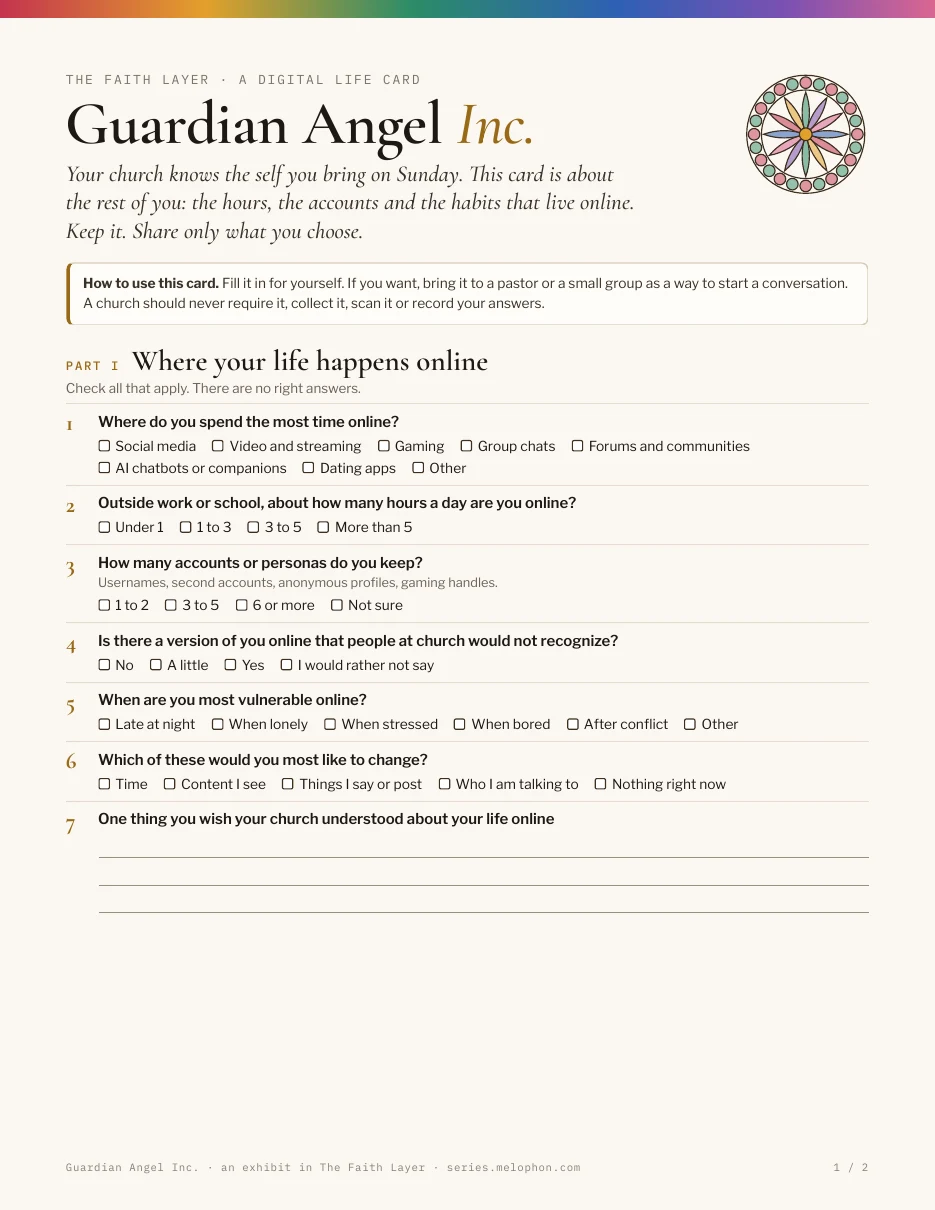
    Page one of the Digital Life Card: a title, a small stained glass rose, instructions and six check-box questions about where a person's life happens online.
    TAKE IT HOME · FOR CONGREGATIONS

    A Digital Life Card your church can hand out

    Two printable pages. A member fills it in privately: where their life happens online, how many selves they keep, what they would want the church to know and never know, and where they would welcome care, without having to name anything.

    The second page carries five commitments for church leaders, starting with the most important one: never collect the answers. The card is a conversation starter, not a data form. INFERENCE

    Download the card · PDF, 2 pages, Letter
    Free to print and share. Not legal or clinical advice.
    WHERE THIS SITS IN THE ATLAS

    The second Faith Layer exhibit, and the closest to S2·09 The Synthetic Self: a companion is a synthetic other, and for a teenager it can become a synthetic confessor. It joins two earlier pages, Guardian Angel Inc. and The Companion Confessor, into one arc, because the church's design question and the teenager's night are the same question asked at different hours. Its logs are the raw material of S2·10 The Afterlife of Your Data; its pull at 2 a.m. is S2·04 The Influence War at its most intimate; a church that links a member's selves is building what S2·06 called a composite. Room E returns in Exhibit 05, The Second Death, when the voice that changes belongs to the dead, and the hours themselves are the subject of Exhibit 06.

    SOURCES
    1. Religion Unplugged / MinistryWatch, "Gloo Mines Big Data to Connect Seekers with Churches," 2 and 3 Nov 2022, describing the 2021 Wall Street Journal profile
    2. The Christian Post, "More than 30K churches using big data from tech firm Gloo to target new members"
    3. Pasquale Pillitteri, "AI Jesus in a Swiss Church: What Really Happened With Deus in Machina" (installation dates, conversation and feedback counts)
    4. America Magazine, "Vatican document on artificial intelligence" (Antiqua et Nova), 28 Jan 2025
    5. TechCrunch, "Sam Altman warns there's no legal confidentiality when using ChatGPT as a therapist," 25 Jul 2025
    6. MIT Technology Review, editor's note withdrawing "When tech gets religion," 4 Sep 2025 (read at primary)
    7. Axios, "Meet chatbot Jesus: Churches tap AI to save souls, and time," 12 Nov 2025
    8. Gloo press release, "AI is Becoming a Spiritual Authority in Americans' Lives," 19 Feb 2026 (Barna Group with Gloo)
    9. Magnifica Humanitas, summary and quotations, Wikipedia (encyclical published 25 May 2026)
    10. Gloo press release, "Majority of Pastors Use AI in Ministry Amid Concerns and Caution," 16 Jun 2026 (Barna Group, n=442 pastors)
    11. DatacenterDynamics, "Data center developer Black Chamber looks to buy Virginia church next to planned AWS campus," 29 Jun 2026
    12. ABC7 / CNN Wire, "Vallejo pastor creates AI version of himself," 25 Aug 2026
    13. Christianity.com, "California Pastor Takes Ministry into the AI Age, Creates Digital Clone of Himself," updated 8 Sep 2026
    14. Ghost, product page for Ghost Core (company claims, read at primary)
    15. Oki Home, product page (company claims, read at primary)
    16. Church Law & Tax, "What's Protected by the Clergy-Penitent Privilege"
    17. TechCrunch, "72% of U.S. teens have used AI companions, study finds," 21 Jul 2025 (Common Sense Media, NORC, n=1,060 ages 13 to 17)
    18. NBC Los Angeles, "Young people prefer in-person faith guidance," 19 Aug 2026 (Center for Scholars & Storytellers, n>2,000 ages 16 to 24)
    19. Crosswalk, Barna State of the Church findings on AI and spiritual advice, Feb 2026 (updated Oct 2026)
    20. Simon Willison, on the 9 Oct 2025 order ending OpenAI's blanket log-preservation requirement
    21. OpenAI, "Introducing parental controls," 29 Sep 2025, updated Jul 2026 (read at primary)
    22. Implicator, "Anthropic's five-year data plan for Claude consumer users," 28 Aug 2025
    23. Tom's Guide, "Meta will use your AI chats to target ads," Oct 2025 (effective 16 Dec 2025)
    24. FTC, "FTC launches inquiry into AI chatbots acting as companions," 11 Sep 2025 (read at primary)
    25. TechCrunch, "California becomes first state to regulate AI companion chatbots," 13 Oct 2025 (SB 243)
    26. TechCrunch, "Character.AI is ending its chatbot experience for kids," 29 Oct 2025
    27. eWeek, "Google and Character.AI settle teen lawsuits," 8 Jan 2026
    28. IANS, "Users mourn the loss of their companion as OpenAI retires GPT-4o," 15 Feb 2026
    29. Global Policy Watch, "Senate Judiciary Committee advances GUARD Act," May 2026
    30. Imagery: Infera image archive, made with Midjourney; no real congregation, person or teenager is depicted. Candles, rose window, clock, threads and timeline are drawn in code from the data.